RPE Training for Intermediates: The 1-10 Scale That Ends Guesswork
Affiliate disclosure: Some links on this page may earn us a small commission at no cost to you.
The spreadsheet does not care that you slept four hours
There is a special kind of betrayal that happens about fifteen minutes into a workout, when you realize your body never got the memo your program sent it. The plan says 5 sets of 5 at 82.5%. Your body, operating on four hours of sleep and a pre-workout banana you ate at a red light, has other ideas. The first set moves like the bar is packed with wet sand. By set three you are staring at the ceiling wondering whether your program was written by someone who believes every Tuesday feels the same.
Beginners mostly do not have this problem. When you can add five pounds to the bar every session, your body overpowers the noise. Sleep, stress, a skipped lunch, all of it gets absorbed by the absurdity of newbie gains. Then, somewhere around the time adding weight stops being automatic, the noise starts winning. This is the moment RPE becomes the most useful tool you own.
What RPE actually is (and where it came from)
RPE stands for rate of perceived exertion. It started as a cardio thing. A Swedish physiologist named Gunnar Borg built a 6-to-20 scale so people could rate how hard exercise felt, no heart rate monitor needed. The range was deliberately chosen to track heart rate divided by ten, so a 15 lands near 150 beats per minute. Clever, in a lab-coat way.
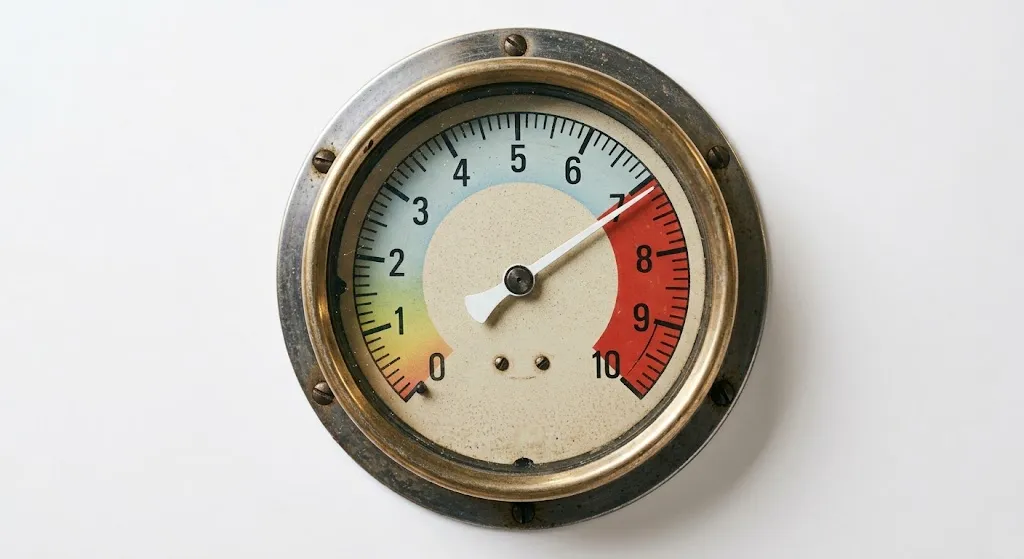
Then in 2016, a research team led by Dr. Michael Zourdos dragged the concept into the weight room and made it useful. Their move was simple. Instead of asking “how hard did that feel,” which is hopelessly vague, they tied every number on the scale to a specific number of reps in reserve. RPE 10 means you could not have done another rep. RPE 9 means exactly one more was left in the tank. RPE 8 means two. Down to about RPE 6, which is four reps in reserve and warm-up territory. Half points exist for the in-betweeners: 8.5 sits somewhere between one and two reps left.
The scale stops at 6 for a reason. Below that, you are estimating reps you will never do. Everyone knows exactly when they are about to die, and accuracy lives near the top of the scale.
Why percentages quietly stop working
A percentage-based program is a prediction. It predicts that your 80% today is the same as your 80% last Tuesday, which quietly assumes your strength is a fixed number rather than a weather system. Your actual readiness shifts with sleep, stress, nutrition, caffeine, soreness, and about twenty variables a spreadsheet cannot see. So they prescribe the same weight on your best day and your worst day. On good days you leave gains on the table because the prescribed weight was too easy. On bad days you grind yourself into dust because the program said so.
RPE solves this by prescribing effort instead of load. “5 reps at RPE 8” means pick a weight where five reps leaves two in the tank. On a great day that might be 275. On a rough day it might be 255. Either way you hit the intended stimulus, which is what the program was trying to give you all along. The percentage was always just a middleman. RPE cuts him out.
If you are coming from percentage-based programming and want to translate your numbers across, our guide to estimating your 1RM without maxing out shows how to work backward from a submaximal set. The two tools pair well: use the 1RM estimate to pick a sane starting load, then let RPE fine-tune it day by day.
Your gut is a better instrument than you think
All of this sounds suspiciously like “trust your feelings,” which is why it is worth knowing the research backs it up.
Zourdos and colleagues (Journal of Strength and Conditioning Research, 2016) tested the RIR-based RPE scale directly and found a strong relationship between reported RPE and actual proximity to failure, confirmed with bar-velocity measurements. The key finding for you: experienced lifters were noticeably accurate at rating their effort, while novices were shakier, particularly at lighter loads where there is no grinding feedback to read. Accuracy is a skill, and it improves with practice. The intermediate lifter, not the beginner and not the elite competitor, is exactly who this tool is built for.
A 2017 study by Helms and colleagues took fifteen powerlifters up to a true 1RM on squat, bench press, and deadlift, then asked for an RPE at the top. Across all three lifts, lifters reported roughly 9.6 to 9.7, tightly clustered. That is remarkable consistency. At a genuine max, lifters across different lifts and different bodies all landed on essentially the same number. The same study found very strong correlations (r = 0.88 to 0.91) between percentage of 1RM and RPE, and concluded RPE is a genuinely useful tool for prescribing intensity alongside or instead of fixed percentages. You can read the full paper on ResearchGate.
More recent work adds a useful caveat. Research on estimating reps to failure found that errors balloon to more than two reps when lifters are seven or more reps from failure, but shrink to about one rep when they are within five of failure. Translation: your RPE 9 is trustworthy. Your RPE 4 is a weather forecast. Use the scale where it is sharp. (The study, published in Sports, also confirmed that training experience improves accuracy, which is another reason this tool fits intermediates better than beginners.)
How to actually use it
Step one is calibration, and it is not optional. You cannot rate effort accurately until you know what the top of the scale feels like. The honest way to learn: on a safe exercise, occasionally take a set close to or all the way to failure and check your estimate against reality. Call it RPE 9, then attempt the rep. If you got it, your gauge works. If you failed, you just recalibrated and got a hard set out of the bargain. Do this on machines and isolation work, not under a heavy squat. A failed rep on a leg press is a story. A failed rep under a back squat is a video someone else posts.
Once calibrated, here is how the numbers map to goals. For strength work (1 to 5 reps), live at RPE 7.5 to 9.5 on main lifts: one top set at RPE 8.5 to 9, then back-off sets at 7.5 to 8. For hypertrophy (6 to 15 reps), RPE 7 to 9 across working sets. Anything under RPE 6 is warm-up or technique work. RPE 10 is a testing tool, not a training tool. Living there earns you a plateau and a physical therapist.
A sample squat day for an intermediate might look like this: work up to 5 reps at RPE 8, then reduce the weight slightly and do two more sets of 5 at RPE 8. That is the entire prescription. Notice what is missing: a target weight. You discover the weight during the warm-up. If the top set turned out to be 275, your log reads “5 x 275 @ RPE 8,” and next week you try to beat it or match it at a lower RPE. Progression becomes automatic again, not because the spreadsheet said so, but because the scale tells you when you are ready for more.
If you want a full program that uses this kind of autoregulation, our 8-week powerbuilding program builds top sets and back-off work into every week.
The three ways people break it
First, the RPE 10 everything problem. If every working set gets rated 9.5 or 10, the scale has no range, and you are just yelling. If you cannot remember your last RPE 7, you are not using RPE. You are using hope with extra steps.
Second, sandbagging. RPE is honest only if you are honest. If you rate a set RPE 8 when it was really RPE 6 because you do not feel like adding weight, you have built a self-regulation tool out of self-deception. The training log keeps you honest here. If your estimated RPE never matches what the reps suggest, something is off, and it is usually the lifter.
Third, rating exercises you cannot judge. New movements, high-rep sets where the burn masks everything, and sets stopped for technical breakdown rather than muscular effort all degrade accuracy. Use RPE on movements you have done a hundred times. On everything else, use conservative loads and a “leave a few in the tank” rule until the movement is familiar enough to rate.
The vegan footnote
There is one more reason this matters on a plant-based diet. Your readiness fluctuates with fueling, and vegan lifters can swing a little harder than average: lower glycogen on a low-carb day, a heavier stomach after a big bean-heavy meal, caffeine from the usual oat-milk latte or not. (My creatine piece covered one way to flatten part of that curve.) RPE does not care why today feels different. It just asks you to rate today. That makes it the right tool for a body that runs on plants and the occasional chaotic Tuesday.
The takeaway
RPE is not an excuse to skip hard work. It is the opposite: a system for making sure the hard work lands at the right dose, on the day you are actually having. Percentages assume your body is a machine. RPE admits it is a person, and trains it like one, which turns out to be the faster way to make it strong.
Keep reading

How to Estimate Your 1RM Without Maxing Out
Estimate your one-rep max without maxing out. How the Epley, Brzycki, O'Connor, and Lombardi formulas work, and when to trust them.
By Ben B.

Breaking Through a Strength Plateau: How to Start Progressing Again
Stuck at the same weight for weeks? How to audit your training, fix the real cause of a strength plateau, and start progressing again.
By Ben B.

Deload Weeks Done Right: A Lifter's Guide
A deload week is not quitting. It's the fatigue-management tool competitive lifters use every 4-8 weeks. Here's the science and the exact protocol.
By Ben B.