Creatine for Vegan Lifters: The One Supplement Actually Worth Buying
Affiliate disclosure: Some links on this page may earn us a small commission at no cost to you.
If you have ever stood in a supplement aisle as a vegan, you know the routine. Some guy who is either trying to sell you something or become your gym best friend asks what you take. You say “just protein powder,” and he looks at you the way a mechanic looks at a car with no engine. “Bro, you’re vegan? You NEED creatine.” He is right about the conclusion, though probably for the wrong reasons, and he has probably never read a single study.
Here is the part nobody in the aisle tells you: creatine is not just a good supplement for vegan lifters. Research in vegetarians suggests people eating plant-based may benefit from it MORE than meat eaters. That is a rare sentence in nutrition. Enjoy it.
What creatine actually does in your body
Your muscles run on ATP, adenosine triphosphate, which is basically cash money for cellular work. The problem is that your muscles store about enough ATP for ten seconds of hard effort. Then they need a refill. That is where creatine comes in. It hangs around in the muscle as phosphocreatine, donating its phosphate group to rebuild ATP on the spot. No phosphocreatine, no good heavy triples.
When you saturate your muscles with creatine, you squeeze out an extra rep or two per set on the movements that matter. Over weeks and months, those extra reps compound into more strength and more muscle. This is the boring, unsexy truth about how supplements build muscle: none of them build muscle directly. Creatine lets you do slightly more work, and the work builds the muscle.
The vegan catch: you are starting from behind
Here is where it gets interesting. Your body makes about one gram of creatine per day on its own, built from arginine, glycine, and methionine. Meat eaters get another gram or two a day from their food, because animal muscle is loaded with the stuff. As a vegan, you get exactly zero from your diet. Nobody is surprised by this. What is surprising is how big the gap gets: research consistently shows that vegetarian and vegan diets leave muscle creatine stores noticeably lower than omnivore diets.
That sounds like bad news, and it is, until you flip it around. Creatine supplementation works by filling up muscle stores, and you cannot overfill them. Meat eaters walk around with their tanks three-quarters full, so a supplement just tops them off. Vegans walk in with the tank half empty. More headroom means a bigger response.
This is not theory. In 2003, Burke and colleagues ran an eight-week study putting vegetarians and omnivores on the same creatine protocol and the same high-volume resistance program. The vegetarians saw bigger increases in muscle creatine and phosphocreatine, bigger gains in lean tissue mass, and better performance on a 50-rep muscular endurance test. The group with the emptiest tanks got the most out of filling them. (Burke DG et al., Medicine and Science in Sports and Exercise, 2003.) One important note: that study enrolled vegetarians, not vegans specifically. But vegans start with even lower dietary creatine intake than vegetarians, so the same logic points the same way, only more so. A 2020 systematic review of creatine supplementation in vegetarians reached the same conclusion: the lower your starting stores, the bigger the response.
What the actual research says (not the gym bros)
The International Society of Sports Nutrition published its position stand on creatine in 2017 after reviewing the whole body of literature. Their conclusions, in plain English:
- Creatine monohydrate is the most effective legal performance supplement available for increasing high-intensity exercise capacity and lean body mass during training. That is their wording, not a marketing claim.
- In long-term studies, people taking creatine typically gain about twice as much fat-free mass as people taking a placebo: roughly an extra 2 to 4 pounds of muscle over 4 to 12 weeks of training.
- It is safe. They found no evidence that short-term or long-term use harms healthy individuals, and they note it was well tolerated at doses up to 30 grams per day for five years. Your 5-gram scoop is a rounding error next to that.
- Creatine users in heavy training actually reported less cramping, dehydration, and muscle strains than non-users in several studies. The old “it dehydrates you” line has it backwards.
Two myths deserve a proper burial while we are here. First, kidney damage. This one comes from case reports and confused bloodwork: creatine raises creatinine, which is a marker doctors watch, but it does not damage the kidneys. The ISSN found no compelling evidence of harm to renal function in healthy people. If you have existing kidney disease, talk to your doctor, like you would with everything. Otherwise, this one is settled.
Second, hair loss. One small 2009 study on rugby players found that creatine raised DHT, a testosterone byproduct linked to hair loss, by about 56% during the loading phase, though levels stayed within the normal range. No hair loss was actually measured in anyone. That DHT finding has not been widely replicated in later trials, and a 2025 randomized trial that measured hair density, follicle count, and hormone levels directly over 12 weeks found no changes from creatine. The 2009 result remains an unconfirmed outlier, not a verdict.
How to take it: the uncomplicated version
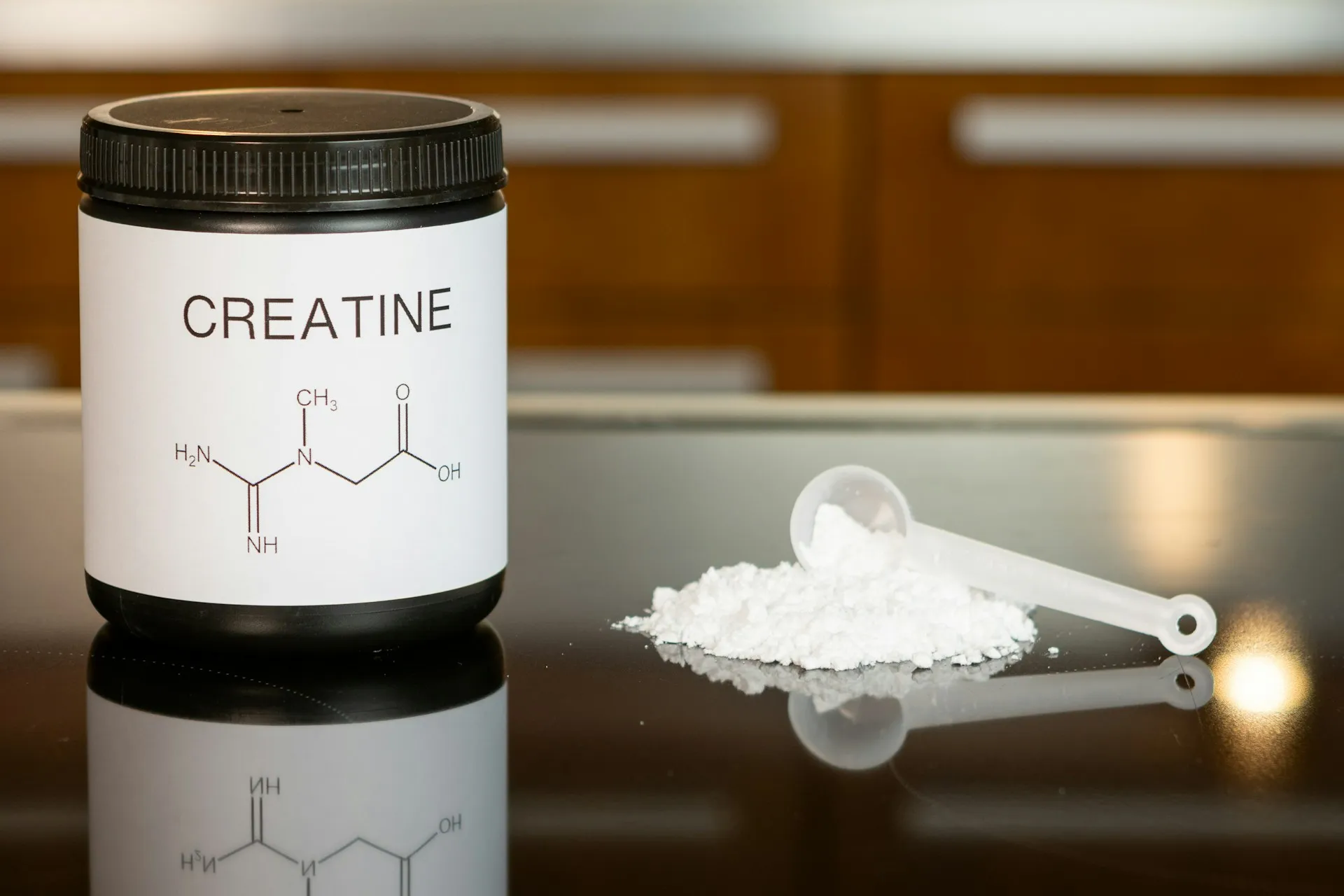
Buy creatine monohydrate. Not creatine HCl, not buffered creatine, not creatine ethyl ester, not anything with a dragon on the label. Monohydrate is the most studied form, the most effective form, and conveniently the cheapest. The fancy versions exist to solve problems monohydrate does not have.
Take 3 to 5 grams per day, every day. Timing does not matter in any meaningful way. Post-workout has a whisper of an edge in some studies, but the real variable is consistency: take it on rest days too, or your stores drift back down. Some people mix it into their protein shake. I mix mine into whatever I am drinking after training and forget about it.
You can skip the loading phase. The classic protocol is 20 grams a day for five to seven days, then 3 to 5 grams daily. It fills your stores in a week instead of a month. It also costs four times as much up front and is the reason half the internet thinks creatine causes stomach cramps. Just take 3 to 5 grams daily and you will be fully loaded in three to four weeks. Your muscles do not know the difference, and your stomach will thank you.
It costs almost nothing. A tub of plain micronized creatine monohydrate runs about twenty to twenty-five dollars for roughly a hundred servings. That is about twenty cents a day. If your supplement budget is limited, and let us be honest, whose is not, creatine should be the first thing in the cart and everything else is a distant second.
The vegan buying guide
Good news: creatine monohydrate is made in a lab from sarcosine and cyanamide. It is synthesized, not extracted from animals, so it is vegan by manufacturing. There is no cow hiding in your creatine.
A few things to check anyway:
- Get plain powder, not capsules, unless the capsules are explicitly veggie caps. Regular capsules are often gelatin.
- Look for “micronized” on the label. It mixes better and does not leave gritty residue at the bottom of your shaker.
- If you want extra confidence, buy a third-party tested product (look for Informed Sport or NSF Certified for Sport on the label). This is less about veganism and more about making sure the tub contains what it says, which is a shockingly low bar in this industry.
- Skip blends and pre-workouts that list creatine as one of forty ingredients. You want the dose, not the marketing.
The honest caveats
Creatine is not magic, and anyone selling it that way is lying. It does nothing for you if you are not training with progressive overload. It will not rescue a program where you do the same weights forever. If that sounds like your training, learn how to actually push yourself with RPE training for intermediates. Creatine amplifies good training. It cannot replace it.
A small fraction of people are “non-responders” whose muscle stores barely budge with supplementation, likely because their stores were already high or their fiber makeup does not play along. If you are a vegan, you are less likely to be in this group, since your starting point is lower. But if you take it for two months and notice nothing, you are not broken. It is just not your lever.
Also worth saying plainly: the extra weight you gain in the first couple of weeks is mostly water pulled into the muscle cells. That is not a bad thing (hydrated muscle cells are happy muscle cells) and it is not bloating, but if the scale jumps two pounds in week two, that is water, not two pounds of new muscle. Muscle still takes time.
The bottom line
Most of the supplement industry is a tax on insecurity. Creatine is the exception. It has more research behind it than almost anything else in the store, it costs pennies a day, it is naturally vegan, and the best evidence we have (in vegetarians, who start with lower stores just like vegans do) says the people starting from the lowest baseline get the most out of it. One scoop, every day, in whatever you are already drinking. That is the whole protocol.
Keep reading

Vitamin D Deficiency: How To Prevent It?
Vitamin D deficiency is common on vegan diets. Sources, daily requirements by age, and how to prevent it.
By Prakash B.
Best Vegan Protein Powders 2026: Buyer's Guide
What actually matters when buying vegan protein powder in 2026, the lead-in-protein findings explained, and 5 top-tier picks.
By Dante C.

How to Choose a Vegan Eating Plan That Actually Works
Not sure which vegan diet approach fits your goals? Learn the 6 eating archetypes and find the one that matches your lifestyle.
By Ben B.