The 6-Week Dumbbell-Only Hypertrophy Program: Two Weights, Your Whole Body
Affiliate disclosure: Some links on this page may earn us a small commission at no cost to you.
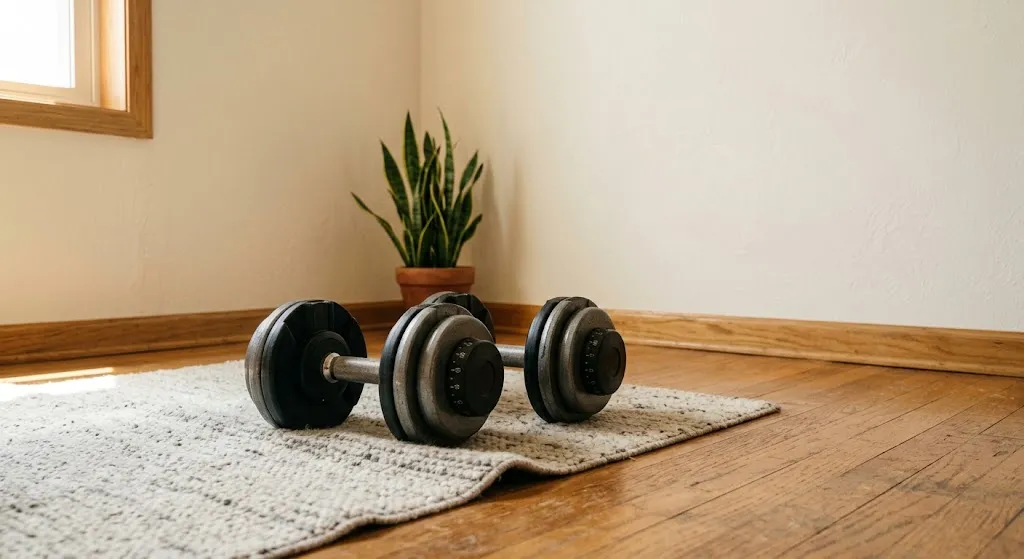
For most of my first two years lifting, my gym was a pair of adjustable dumbbells, a flat bench, and a rug that slowly slid toward the wall every time I did hip thrusts. I did not own a barbell. I could not have told you what a power rack was. And my body grew anyway, because muscle does not check what brand of iron you are using. It checks how hard the set was, how many hard sets you did this week, and whether the weight went up over time. Dumbbells handle all three just fine.
This program is the six-week plan I wish someone had handed me back then. It is an upper/lower split, four days a week, built entirely around dumbbells and a bench. Every day is written out: exercises, sets, reps, rest periods, and the exact progression rule that tells you when to add weight. No interpretation required.
Dumbbells are not a compromise
People talk about dumbbell-only training like it is the diet soda of lifting: acceptable until you get the real thing. The research disagrees. A 2013 study by Saeterbakken and Fimland, published in the Journal of Strength and Conditioning Research, found the dumbbell bench press produced greater pectoralis major activation than the barbell version at equivalent relative loads. More recently, a 2025 meta-analysis of nine controlled trials found no significant difference in hypertrophy between bilateral barbell-style training and unilateral dumbbell-style training. And Schwanbeck’s group showed that machine-only and free-weight-only programs grew muscle similarly. The pattern is consistent: muscle growth tracks volume and effort, not the shape of the implement.
Dumbbells even have honest advantages. Each arm works independently, so your dominant side cannot keep covering for the weaker one the way it does on a barbell. The stability demand is higher, which is free core and shoulder-stabilizer work baked into every pressing and rowing movement. And failure is safer: a failed dumbbell press means setting two weights on the floor, not getting pinned under a bar while making the sound that announces your arrival at physical therapy.
The real drawback is loading granularity. Most adjustable dumbbells jump in 2.5 to 5 pound increments per hand. That is fine for goblet squats and rows. It is brutal for lateral raises and curls, where 5 pounds can be a 20 percent jump. The progression scheme below is built around this problem.
Who this is for (and the equipment)
For: lifters with 3+ months of experience who know basic movement patterns. You should be able to do a push-up, a bodyweight squat, and a hip hinge without coaching. Beginners can run this, but they should spend the first two weeks learning the movements at light weights before worrying about progression.
Skip it if: you have a full gym at your disposal and no constraints. This program will absolutely grow muscle, but a barbell program lets you load heavy compounds more efficiently. This exists for people with two dumbbells and ambition.
Equipment: a pair of adjustable dumbbells that go to at least 50 pounds per hand (90 is better), and a bench. A flat bench works; an adjustable one that inclines is worth the upgrade. A few square feet of floor. That is the whole equipment list.
How the six weeks work
Four training days per week: Upper A, Lower A, Upper B, Lower B. Each muscle group gets hit twice a week, which keeps you at roughly 8 to 12 hard sets per major muscle group weekly. That lands right in the range Schoenfeld’s 2017 meta-analysis (Journal of Sports Sciences) associated with the best hypertrophy outcomes: 10 or more weekly sets beat fewer, with diminishing returns beyond about 20.
Notation: 4x8-12 means 4 sets of 8 to 12 reps. Rest 2 to 3 minutes on the first two exercises of each day (the heavy compounds), 60 to 90 seconds on everything else.
Progression (double progression): this is the whole engine. Pick a rep range, say 8-12. Choose a weight you can do for at least the bottom of the range. Each week, add reps. When you can hit the top of the range on every set, increase the weight by the smallest increment you have and drop back to the bottom of the range. Example: you do dumbbell bench press 4x8-12 with 60s. Week 1: 8, 8, 7, 7. Week 2: 9, 8, 8, 8. Week 3: 10, 10, 9, 9. Week 4: 12, 12, 11, 12. Next session: 65s for sets of 8. That is it. You never guess; the rep range makes the decision for you.
The week-by-week shape: Weeks 1 and 2 are baseline weeks. Learn the movements, log your weights, leave 2 to 3 reps in reserve on everything. Weeks 3 through 5 are the build. Push every working set to 1 to 2 reps in reserve and follow the double progression honestly. Week 6 is a deload: cut every exercise to half the listed sets, use the same weights, stop everything at 3 to 4 reps in reserve. Then start a new six-week cycle with your new weights as the baseline.
Day 1: Upper A
| Exercise | Sets x Reps | Notes |
|---|---|---|
| Flat dumbbell bench press | 4 x 8-12 | 2-3 min rest, touch chest each rep |
| One-arm dumbbell row | 4 x 10-15 / side | Opposite hand on bench, pull to hip |
| Standing dumbbell shoulder press | 3 x 8-12 | Squeeze glutes, no leg drive |
| Incline dumbbell curl | 2 x 10-15 | Bench at 45 degrees, full hang stretch |
| Overhead dumbbell triceps extension | 2 x 10-15 | One dumbbell, both hands |
Day 2: Lower A
| Exercise | Sets x Reps | Notes |
|---|---|---|
| Goblet squat | 4 x 10-15 | Dumbbell at chest, elbows between knees |
| Dumbbell Romanian deadlift | 4 x 10-12 | Hinge at hips, slight knee bend, feel hamstrings |
| Bulgarian split squat | 2 x 10-12 / leg | Rear foot on bench, torso tall |
| Standing dumbbell calf raise | 3 x 12-20 | One dumbbell, pause at the bottom |
| Dumbbell farmer’s carry | 3 x 40 seconds | Heavy pair, walk tall, don’t shrug |
Day 3: Upper B
| Exercise | Sets x Reps | Notes |
|---|---|---|
| Incline dumbbell bench press | 3 x 8-12 | Bench at 30 degrees |
| Chest-supported dumbbell row | 4 x 10-12 | Prone on incline bench, pull to ribs |
| Dumbbell lateral raise | 3 x 12-15 | Stop just below shoulder height |
| Hammer curl | 2 x 10-12 | Neutral grip, control the negative |
| Close-grip dumbbell floor press | 2 x 10-15 | Lying on floor, dumbbells pressed together |
Day 4: Lower B
| Exercise | Sets x Reps | Notes |
|---|---|---|
| Dumbbell reverse lunge | 3 x 10-12 / leg | Step back, not forward, kinder on knees |
| Single-leg dumbbell Romanian deadlift | 2 x 10-12 / leg | Light, balance is the limiter here |
| Dumbbell hip thrust | 4 x 12-15 | Upper back on bench, dumbbell on hips |
| Dumbbell step-up | 2 x 10-12 / leg | Bench or sturdy box, drive through heel |
| Weighted plank | 3 x 60 seconds | Dumbbell flat on lower back |
Three things people get wrong with dumbbell programs
First, they go too light on legs. Legs need load, and dumbbells make it easy to sandbag because holding heavy weights in your hands is uncomfortable. The Bulgarian split squat and reverse lunge exist specifically to make your legs work hard while the dumbbells stay manageable. If your legs finish a session feeling fresh, you did not do enough. Bump the weight.
Second, they ignore the rest periods. Sixty seconds between heavy bench sets turns a strength exercise into a cardio exercise. The 2 to 3 minute rests on the first two movements of each day are part of the program, not a suggestion. Set a timer. I did not, for about a year, and I plateaued the entire time.
Third, they skip the warm-up and then complain about shoulders. Two minutes: arm circles, band pull-aparts if you have a band, then one light set of 15 on the day’s first pressing movement and one light set on the day’s first leg movement. That is the warm-up. Skipping it saves six minutes and costs you months.
The vegan footnote
None of this works without protein, and the number to know comes from the International Society of Sports Nutrition: 1.4 to 2.0 grams per kilogram of bodyweight per day for active people building muscle. For a 180-pound lifter that is roughly 115 to 165 grams. Tofu, tempeh, seitan, lentils, and a scoop or two of protein powder get you there without drama; this site’s seitan and tempeh guides are the cheapest path. One more thing worth considering: vegans start with lower baseline creatine stores than meat-eaters, and the research on supplementation is among the strongest in sports nutrition. My creatine piece covers the whole case.
The takeaway
You do not need a barbell to build a physique. You need four days a week, dumbbells you can load progressively, and the discipline to add a rep when the rep range says it is time. Run this for six weeks, log everything, deload, and run it again. The rug will slide. The muscles will not care.
Keep reading
The 6-Week Bodyweight Muscle Program: Build Real Muscle With Zero Equipment
No gym, no weights, no excuses. A 6-week bodyweight hypertrophy program with exact exercises, sets, reps, and a progression system that builds real muscle.
By Ben B.
The Vegan Push/Pull/Legs Program: Your 6-Day Hypertrophy Split, Fully Planned
A complete 6-day push/pull/legs hypertrophy program for plant-based lifters: every set, rep, and progression rule, hitting each muscle twice a week.
By Ben B.
Conditioning for Lifters: The 6-Week Cardio Plan That Won't Eat Your Gains
A 6-week conditioning plan for lifters: zone 2 base plus one interval day, scheduled to keep your gains. Build the engine without the interference.
By Ben B.