The 6-Week Bodyweight Muscle Program: Build Real Muscle With Zero Equipment
Affiliate disclosure: Some links on this page may earn us a small commission at no cost to you.
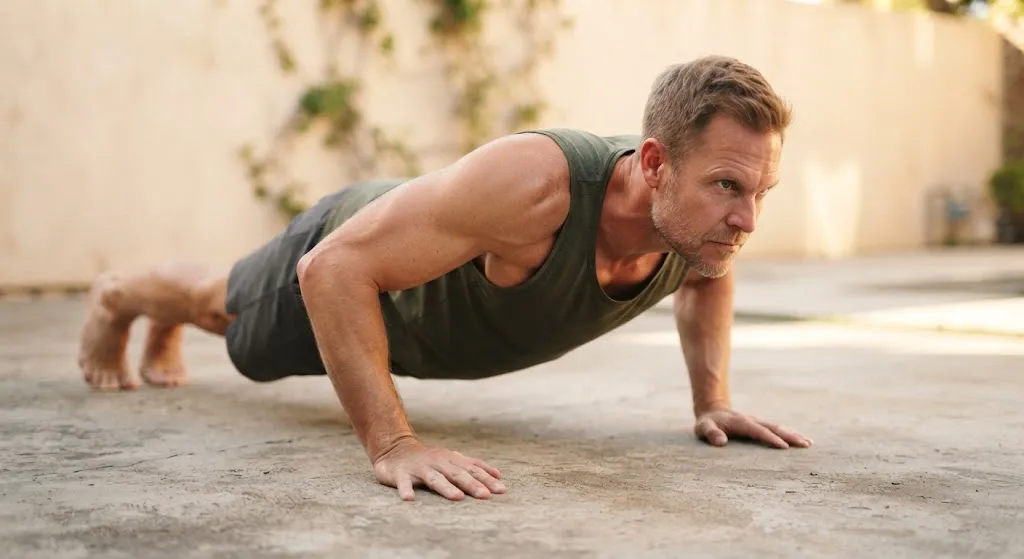
I have a confession: for years I thought bodyweight training was what you did when you couldn’t get to the gym. A maintenance plan. A placeholder. Then my gym closed for three weeks during a renovation, and I ran a bodyweight-only block out of pure stubbornness, and my chest and triceps measurably grew. Not maintained. Grew.
I’m not the only one who’s stumbled into this. In 2017, Kikuchi and Nakazato ran eight weeks of push-up training head-to-head against bench pressing at 40% of 1RM, two sessions a week, and found similar increases in triceps and pectoralis thickness, plus similar strength gains. Kotarsky’s group ran the same comparison with progressive push-up variations versus the bench press over four weeks and found comparable strength gains, though neither group added measurable muscle thickness in that short a window. And the broader load research (Schoenfeld and colleagues’ 2017 meta-analysis comparing low- versus high-load training especially) keeps landing in the same place: take a set close to failure, and the absolute weight on the bar matters far less than we were all taught in the locker room.
The catch is that most bodyweight programs online are garbage. “Do 100 push-ups a day!” is a challenge, not a program. It’s junk volume with no progression, no balance, and no plan for the half of your body below the waist. This is a real program: six weeks, three full-body days a week, with a progression system that works without adding a single plate. All you need is a floor, a sturdy table or doorframe, and a couch your heels can hook under. A doorway pull-up bar helps enormously if you have one (~$30), but every movement has a no-bar substitute.
The one honest limitation
Legs are the constraint. A standard push-up loads roughly two-thirds of your bodyweight through your chest, which is plenty. But bodyweight squats top out fast for anyone who’s trained before. Your quads will get bored around rep 25. So this program attacks legs with unilateral work (one leg at a time roughly doubles the load per limb), slow eccentrics, and high effort. Your legs will grow, but if tree-trunk quads are the goal, this is a bridge program, not a permanent home. Your upper body, on the other hand, has no excuses here.
How progression works with no weights
You can’t add 5 pounds, so you progress two ways instead:
1. The rep ladder. Each movement has a rep target range (say, 8–12). Start at the bottom. Each session, add a rep or two. When you can hit the top of the range with 1–2 reps still in the tank, you graduate.
2. The variation upgrade. This is your “adding weight.” Every exercise has three levels. When you max out the rep range at Level 1 with good form, you move to Level 2 and restart at the bottom of the range. Harder variation, fewer reps, same progression. It never stops working.
Effort rule: stop 2 reps shy of failure in weeks 1–2, 1 rep shy in weeks 3–4, and 0–1 reps shy in week 5. Leaving a little in reserve keeps your form honest and your joints happy; going to true failure on every set is how you earn tendinitis, not muscle.
The rep test (do this before Day 1)
Good form only: chest to a fist’s height off the floor on push-ups, full lockout, no worming. Record your max reps for: standard push-ups, inverted rows (or table rows), Bulgarian split squats per leg. Retest at the end of week 6. These numbers are your scoreboard.
The workouts
Three days a week (Monday/Wednesday/Friday or any non-consecutive days), alternating A and B: week 1 goes A-B-A, week 2 goes B-A-B, and so on. Warm up with 2 minutes of arm circles, leg swings, and 10 easy reps of the day’s first movement. Rest 60–90 seconds between sets, 2 minutes between exercises.
Workout A: Push + Legs
- Push-up variation: 4 sets of 8–12. Level 1: incline push-ups (hands on a chair). Level 2: standard push-ups. Level 3: feet-elevated or archer push-ups.
- Pike push-up: 3 sets of 6–10. Level 1: short pike (hips high, small range). Level 2: full pike push-up. Level 3: feet-elevated pike. This is your overhead press. Don’t skip it; your shoulders will notice.
- Chair dips: 3 sets of 8–15. Level 1: bent knees. Level 2: straight legs. Level 3: feet elevated on a second chair. Keep your shoulders down and away from your ears; if your sternum feels weird, shorten the range.
- Bulgarian split squat: 3 sets of 8–12 per leg. Rear foot on the couch, front foot far enough forward that your knee tracks over your ankle. Level 1: shallow depth. Level 2: full depth. Level 3: 3-second lowering on every rep. These will humble you. That’s the point.
- Walking lunges: 2 sets to near failure (or 60 seconds continuous). Finish the quads off.
- Hollow-body hold: 3 sets of 20–40 seconds. The core work gymnasts actually do.
Workout B: Pull + Posterior + Core
- Inverted row: 4 sets of 8–12. Under a sturdy table, body straight as a plank, pull your chest to the edge. Level 1: knees bent, body more upright. Level 2: legs straight. Level 3: feet elevated. This is your barbell row. Treat it with the same respect.
- Pull-up or substitute: 3 sets of 3–8. If you have a bar: Level 1 is 5-second negatives (jump up, lower slowly), Level 2 is full pull-ups, Level 3 is chest-to-bar or slow 3-second negatives. No bar: do towel rows. Drape two towels over the top of a sturdy door (door closed, towels on your side), lean back, and row your bodyweight up. It looks ridiculous. It works.
- Nordic curl negatives: 3 sets of 3–5 reps. Heels hooked under the couch, lower your torso toward the floor as slowly as possible, catch yourself with your hands, push back up. Level 1: lower halfway. Level 2: full negatives. Level 3: full negatives with a 5-second descent. Your hamstrings have never met anything like this. Walk, don’t run, into week 1. Two days of soreness-induced stairs regret is normal.
- Single-leg hip thrust: 3 sets of 10–15 per leg. Shoulders on the couch, one foot planted, drive your hips up and squeeze the glute hard for a full second. Level 1: both feet down. Level 2: single leg. Level 3: single leg with a 2-second pause at the top.
- Single-leg calf raise: 3 sets of 12–20 per leg, off the edge of a step. Full stretch at the bottom, full squeeze at the top. Calves respond to volume and range of motion. Give them both.
- Hanging knee raises or lying leg raises: 3 sets of 10–15. Slow and controlled; if your hip flexors take over, shorten the range until your abs are doing the work.
The six-week arc
- Weeks 1–2: Foundation. Three sets per movement instead of the listed four (rows and push-ups stay at 3), stop 2 reps shy of failure, and obsess over form. You’re learning the levels and finding your starting variation. This should feel almost easy. That’s correct.
- Weeks 3–4: Build. Full sets as written. Stop 1 rep shy of failure. Add 1–2 reps per session wherever you can. Most people graduate at least one movement to the next level during this block. That little ceremony is the whole game.
- Week 5: Push. Hardest variation you can perform with clean form, sets to 0–1 reps in reserve. This is the week that grows the muscle. Sleep and eat like you mean it.
- Week 6: Deload, then retest. Two sessions only, half the sets, stop 3+ reps shy of failure. It should feel like a warm-up. Then rest two days and redo the rep test. Compare the numbers. That’s your receipt.
Eating for it
Training is the stimulus; food is the material. Aim for 1.6–2.2 grams of protein per kilogram of bodyweight daily (the ISSN/Morton meta-analysis range: a well-established target, not bro-science), spread across 3–5 meals. If the goal is gaining size, eat in a small surplus of roughly 200–300 calories above maintenance. You cannot build a house without bricks, and no amount of perfect programming fixes an 1,800-calorie day for a 190-pound lifter trying to grow. Tofu, tempeh, seitan, lentils, soy milk, and a scoop of protein powder where needed will get you there without drama. Our high-protein vegan meal-prep recipes keep the portions honest.
What to do after week 6
Run it back. Start week 1 at the variation level you finished at, and the progression ladder keeps working for several more cycles. Most people get 3–4 solid runs before a movement family truly stalls. When standard push-ups at 12 clean reps feel like a warm-up and archer push-ups are your working sets, you’ve built something real out of nothing but a floor and some furniture. And if you eventually walk back into a gym, our 4-week beginner strength program is the natural next step. You’ll find the weights feel suspiciously lighter. Funny how that works.
Keep reading
The Vegan Push/Pull/Legs Program: Your 6-Day Hypertrophy Split, Fully Planned
A complete 6-day push/pull/legs hypertrophy program for plant-based lifters: every set, rep, and progression rule, hitting each muscle twice a week.
By Ben B.
The 4-Week Vegan Beginner Strength Program: Your First 12 Workouts, Fully Planned
A complete 4-week beginner strength program for plant-based lifters: 3 full-body workouts per week with exact sets, reps, and a progression plan.
By Ben B.
Conditioning for Lifters: The 6-Week Cardio Plan That Won't Eat Your Gains
A 6-week conditioning plan for lifters: zone 2 base plus one interval day, scheduled to keep your gains. Build the engine without the interference.
By Ben B.