Iron and B12: The Two Nutrients Your Vegan Lifts Can't Out-Train
Affiliate disclosure: Some links on this page may earn us a small commission at no cost to you.
Protein arguments on vegan fitness forums could power a small city. Macros get all the ink. But after a decade of watching vegan lifters plateau, the culprit is almost never protein. It is the two quiet nutrients that run your oxygen delivery and your nervous system, and you will not out-train a deficiency in either.
Iron and B12. One carries your oxygen, the other wires your nerves and builds your blood. Deficiencies in both feel like “I’m just tired and my training sucks lately,” which is exactly how they hide. Let us get into the actual numbers so you can fix this once and move on.
Why iron is a bigger deal than your squat program admits
Iron is the core of hemoglobin (the stuff in red blood cells that carries oxygen to your muscles) and myoglobin (the stuff that stores oxygen inside muscle tissue). It also sits at the center of a bunch of mitochondrial proteins that make energy. Low iron means your muscles literally get less oxygen and make less energy. Training on low iron feels like doing cardio at altitude while wearing a weight vest. Everything is hard, your recovery is garbage, and your warm-up sets feel like max attempts.
Athletes lose more iron than desk workers: sweat, minor GI bleeding from hard training, foot-strike hemolysis (red blood cells getting smashed in your feet when you run), and the inflammation response after workouts. Female lifters have one more exit route via menstruation. Add a vegan diet’s lower iron bioavailability and you have a perfect little storm.
The numbers: the RDA for iron is 8 mg/day for men and 18 mg/day for premenopausal women. Here is the catch the RDA does not print in big letters: the Food and Nutrition Board recommends vegetarians multiply their RDA by 1.8 to account for the lower absorption of non-heme iron. That turns 8 mg into roughly 14 mg and 18 mg into roughly 32 mg. Do not let that scare you. The target is real but entirely hittable with food once you know which foods matter.
Heme iron (from meat) absorbs at about 15 to 30 percent. Non-heme iron (from plants) absorbs at about 2 to 20 percent, heavily influenced by what you eat alongside it. So a vegan lifter is playing the same game on a harder difficulty, but the difficulty slider is absorption, and absorption is something you can game.
Your iron playbook
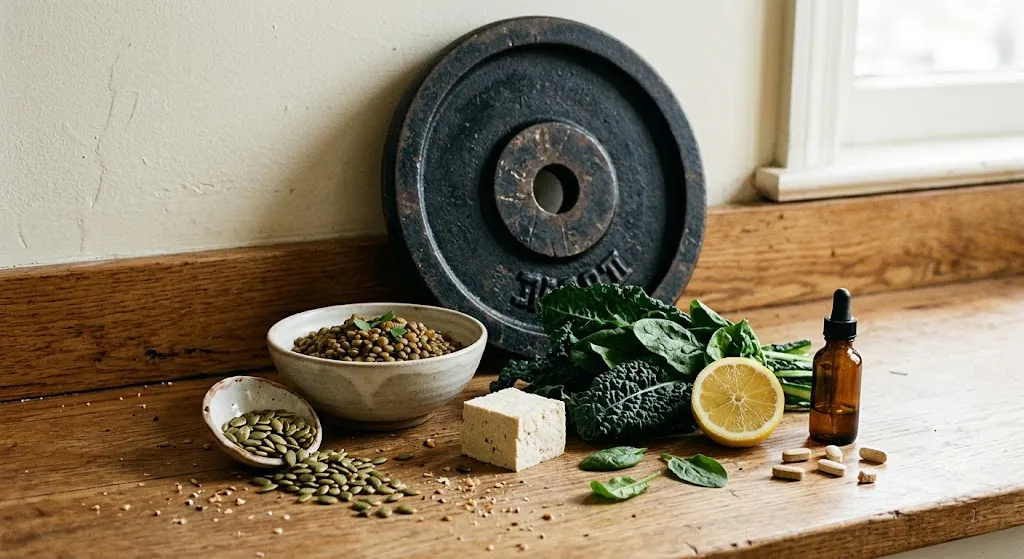
Eat the heavy hitters. These are real numbers per 100 grams, from published nutrition data:
- Soybeans, boiled: 5.14 mg
- Tofu, raw regular: 5.36 mg
- Lentils, boiled: 3.33 mg
- Red kidney beans, boiled: 2.94 mg
- Chickpeas, boiled: 2.89 mg
- Spinach, raw: 2.71 mg
- Black beans, boiled: 2.10 mg
- Pistachios, raw: 3.92 mg
A cup of cooked lentils lands you around 6.6 mg. Half a block of firm tofu with dinner adds several more. Do the math across a day of bean-heavy vegan eating and 14 mg for a guy is not heroic. For women aiming at 32 mg, it takes intention: legumes at most meals, fortified foods, and the absorption tricks below.
Weaponize vitamin C. Vitamin C is the single strongest lever on non-heme iron absorption. It converts iron into a form your gut can grab, and research shows it can even override the inhibitory effects of phytates, polyphenols, and calcium when the ratio is right. Practical version: squeeze citrus on your bean burrito, toss bell peppers into your lentil soup, have berries with your fortified cereal, or put tomatoes in your tofu scramble. The pairs matter more than the individual foods.
Mind the inhibitors. Coffee and tea are iron-absorption killers thanks to their polyphenols. Do not wash down your high-iron meal with a big mug of coffee. Wait an hour or so. Same story with calcium-rich foods eaten in the same bite, though a normal vegan diet makes this less of an issue than it is for omnivores drowning their meals in dairy.
Test, do not guess. If you are chronically dragging and your training stalled for no good reason, ask your doctor for ferritin, hemoglobin, and iron saturation. Ferritin is the storage marker and the useful early-warning one. Normal adult male range runs roughly 24 to 336 ng/mL and female roughly 24 to 307 ng/mL, though “normal” and “athlete-optimal” are not the same conversation. Low ferritin with normal hemoglobin is called stage-one iron depletion, and it is exactly when you want to act.
Supplement smart if you need to. Iron supplements work, but take them on a relatively empty stomach with vitamin C and away from coffee, tea, and calcium. Start with food first unless a doctor told you otherwise. Iron is one of the few supplements where megadosing can genuinely hurt you, so do not freestyle with 100 mg pills.
B12: the non-negotiable supplement
Here is the blunt version: there is no reliable plant source of vitamin B12. Nutritional yeast with added B12 counts as a fortified food, not a plant source. Spirulina and fermented soy products get touted in internet corners, but they mostly contain B12 analogues that your body cannot use and that may actually block real B12 absorption. If you are fully vegan, you supplement B12. This is not a debate. It is plumbing.
B12 matters for lifters because it builds red blood cells, maintains the myelin sheath around your nerves, and participates in cellular energy metabolism. Deficiency creeps: fatigue, brain fog, tingling in the hands and feet, and a training plateau that will not respond to deloads or extra calories. Left long enough, the neurological damage can be irreversible. That sounds dramatic because it is. The fix, though, is one of the cheapest in all of sports nutrition.
The RDA is 2.4 mcg/day, which looks tiny until you realize B12 absorption is comically inefficient. Your gut absorbs it through an “intrinsic factor” pathway that caps out fast, so a 500 mcg pill does not deliver 500 mcg. That is why the doses sound absurd. They are calibrated for the inefficiency.
What actually works for vegans, based on sports nutrition recommendations:
- 25 to 100 mcg daily, or
- 2,000 mcg once weekly, or
- fortified foods (nutritional yeast, fortified plant milks and cereals) eaten consistently, ideally combined with a modest supplement for insurance.
Form matters less than consistency. Cyanocobalamin is the cheapest, most studied, most stable form, and it works fine for the vast majority of people. The methylcobalamin hype is mostly marketing; your body converts cyanocobalamin just fine. Take it in the morning with water. B12 can be mildly stimulating, so right before bed is a needlessly risky experiment.
One caution: B12 is water-soluble, so excess gets excreted and the toxicity floor is practically nonexistent. That is good, but it is not a license to ignore folate. Mega-dosing B12 can mask a folate deficiency on blood work, so keep your leafy greens and legumes in the rotation (you already are) and do not treat a supplement as a substitute for a diet.
Test like you mean it. Standard serum B12 ranges (roughly 200 to 900 pg/mL in most labs) are wide enough to hide real deficiency. Some people start getting neurological symptoms below 400 or 500. If your number is low-normal and you feel off, ask for methylmalonic acid (MMA) and homocysteine. MMA is the sensitive one: elevated MMA means your cells are actually B12-starved regardless of what the serum number says.
What a day of both looks like
This is not a meal plan. It is a pattern:
Morning: Fortified oatmeal or cereal (check the label for iron and B12) topped with strawberries or a glass of OJ on the side. If you supplement iron separately, this is a fine window for it with the vitamin C in the fruit.
Midday: Big lentil or black bean bowl with bell peppers, tomatoes, and lime. That is iron plus its absorption wingman in one bowl.
Pre-workout: Whatever you normally eat. Coffee is fine here, just not glued to your high-iron meals.
Dinner: Tofu stir-fry with broccoli and citrus sauce, or a chickpea curry with spinach. Sprinkle B12-fortified nutritional yeast on either. Take your daily B12 with dinner or in the morning, whichever you will actually remember.
Bedtime: Not the place for coffee or iron pills.
Run that pattern, keep a cheap cyanocobalamin on the counter, and get your ferritin and B12 checked once a year. That is the whole program. It costs maybe five dollars a month and eliminates the two deficiencies most likely to quietly sabotage your training.
Protein will always be the fun argument. Iron and B12 are the ones that keep you in the gym.
Keep reading
Best Vegan Protein Powders 2026: Buyer's Guide
What actually matters when buying vegan protein powder in 2026, the lead-in-protein findings explained, and 5 top-tier picks.
By Dante C.
Creatine for Vegan Lifters: The One Supplement Actually Worth Buying
Creatine is the most studied supplement in fitness, and plant-based lifters may benefit most. Dosage, myths, and what to buy.
By Ben B.

How to Choose a Vegan Eating Plan That Actually Works
Not sure which vegan diet approach fits your goals? Learn the 6 eating archetypes and find the one that matches your lifestyle.
By Ben B.